
One Aging Test Isn’t Enough — You Need the Trend
Health Longevity Brief - Week of July 16, 2026

We are living through a boom in “biological age” tests. Spit in a tube, mail it off, get a number back telling you your body is 47 when your birthday says 53. It’s a compelling pitch. But a study published this week in Nature Aging delivers a quiet, important correction to how we should be using these tools — and it’s the most useful methodological finding I’ve seen in a while.
Researchers at the National Institute on Aging analyzed DNA methylation profiles from 699 European adults (average age ~63), applying seven different epigenetic aging clocks to samples taken at multiple time points — two readings for 376 people, three readings for 323 (nad.com summary of the Nature Aging study). The question was simple: does measuring your aging repeatedly over time predict death better than a single snapshot?
The answer was a clear yes. Faster aging captured across two or three time points robustly predicted higher mortality risk, outperforming any single measurement — with one reported hazard ratio of 1.23, meaning a 23% higher death rate than average. In other words, the slope matters more than the dot. A single biological-age reading is a photograph; what actually forecasts your health is the movie — the direction and pace your aging is moving.
Why does this matter beyond statistics? Because it reframes what these tests are for. A one-time number is easy to over-interpret and easy to sell. But the real value — and the only rigorous way to know whether a diet, an exercise program, or a drug is actually bending your aging curve — is to measure the same person over time and watch the trajectory. This is the difference between a novelty and a tool.
The honest caveats. This is 699 people, all of European ancestry, in an observational dataset — the paper doesn’t fully specify the time span between readings, and the authors are upfront that we still don’t know exactly what cellular changes these methylation shifts reflect. Epigenetic clocks remain proxies, not ground truth. But the takeaway is durable and practical: if you’re going to spend money on a biological-age test, don’t buy one. Buy the baseline, change something real, and buy the follow-up. The trend is the signal.
5 QUICK HITS
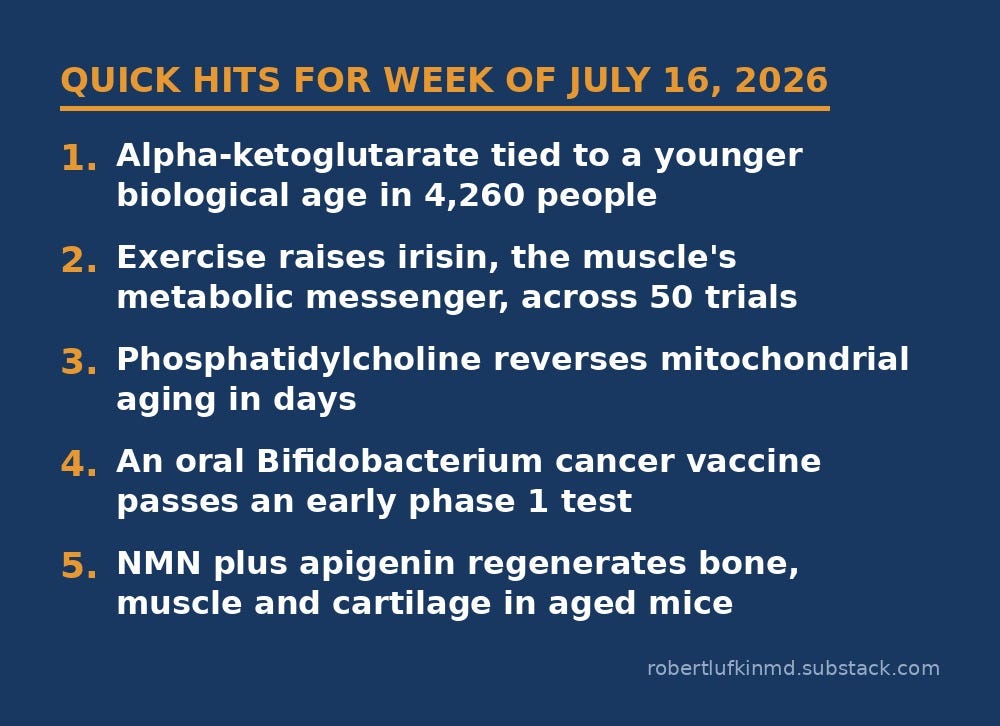
1. A cheap metabolite tied to a younger biological age. In an observational study of 4,260 health enthusiasts published in Aging Cell, users of supplements showed significantly lower biological age than non-users — and delayed-release alpha-ketoglutarate (AKG) was the single supplement most strongly associated with a younger methylation age (nmn.com). AKG sits right at the crossroads of the Krebs cycle — pure metabolism. Big caveat: observational, not randomized, in an unusually health-conscious group, so this is a hypothesis to test, not a prescription.
2. Exercise’s metabolic magic has a messenger — and it’s dose-by-consistency. A meta-analysis of 50 randomized trials in 1,780 adults with overweight or obesity found that regular exercise significantly raises irisin, a muscle-derived signaling protein that improves glucose metabolism and helps turn white fat into metabolically active brown-like fat (NaturalNews summary). Alongside it: lower fasting glucose, better HOMA-IR, lower HbA1c and LDL, higher HDL. The authors’ key point — consistency over weeks and months, not single hard sessions, drives the benefit.
3. A membrane molecule that rewinds mitochondrial aging. In Nature Communications, researchers found that declining phosphatidylcholine is a major, reversible driver of age-related mitochondrial dysfunction — and simply feeding it (or its precursor choline) restored youthful mitochondrial structure in worms within two days, even in advanced age (ScienceDaily). A striking sex-specific note: the sharpest decline in humans clustered around menopause. Caveat: worms and human cell cultures, no human trial yet — but the mitochondrial-energy angle is squarely metabolic.
4. A cancer vaccine you swallow. In an exploratory phase 1 study, a genetically engineered Bifidobacterium — a common gut bacterium — was used as an oral delivery platform for a cancer vaccine, and it was well tolerated while generating both immune and early clinical responses (Medical Xpress oncology roundup). Using the gut microbiome itself as the delivery truck for immunotherapy is a genuinely novel idea. Very early — phase 1, small — but worth watching.
5. NMN + apigenin: an additive NAD+ play. Combining NMN with the CD38 inhibitor apigenin additively boosted NAD+, cut cellular senescence, improved mitochondrial function, and regenerated cartilage, bone, and muscle in aged mice — restoring young-like strength and speed (Aging Cell, via nmn.com). The effect was even mediated partly through beneficial gut bacteria. Firmly preclinical — this is 20-month-old mice, not people.
THE THROUGH-LINE THIS WEEK
Notice what nearly every item on this page has in common: mitochondria, methylation, and metabolism.
The lead says the way to know if you’re aging well is to track the trajectory of your epigenetic clock — which is, at root, a readout of your metabolic and cellular state over time. AKG is a Krebs-cycle metabolite. Irisin is the muscle’s metabolic messenger. Phosphatidylcholine restores the mitochondria — your cells’ power grid. The NMN-apigenin stack works through NAD+, the central currency of metabolism. Even the cancer vaccine rides in on your gut microbiome, itself a metabolic organ.
Here’s the frame I keep returning to: aging isn’t one thing happening to you — it’s the slow drift of your metabolic machinery, and that drift is more modifiable than we used to believe. This week’s message is almost operational. Stop treating a single biological-age number as a verdict. Establish your baseline, then pull the levers that actually move metabolism — consistent exercise, mitochondrial and metabolic support, muscle you build and keep — and re-measure. Watch the slope. If the trend is bending the right way, you’re doing the real work. That’s not a supplement you buy. It’s a system you tend.
GO DEEPER
If this landed, keep going. Subscribe to the newsletter at robertlufkinmd.substack.com to get the Brief in your inbox every week, and dig into the metabolic-root-cause framework on the Health Longevity Secrets podcast, where I take these threads apart with the researchers and clinicians doing the work.
Live well, longer,
Robert Lufkin, MD
This newsletter is for educational purposes only and is not medical advice. It does not replace a personal relationship with a qualified health care professional. Talk with your own physician before changing your diet, exercise, medications, or supplements — especially if you have a medical condition or take prescription drugs.
Exercise, exercise, exercise seems the message
On top of eating right and controlling weight of course
And minimising stress which includes sleeping well
This is a helpful reminder that one measurement rarely tells the whole story. Long-term trends are usually far more meaningful than snapshots.