

Welcome back. This week handed us something rare in the longevity literature: not a mouse study, not a preclinical signal, but two decades of human data confirming what we keep coming back to here — the lever that moves the most disease is the one you control every day.
THE LEAD: A 20-year human trial just showed lifestyle beats the drug at preventing multiple chronic diseases
We talk a lot about single endpoints — lower this number, raise that one. But aging doesn’t arrive one disease at a time. It arrives as multimorbidity: two, three, four conditions stacking up at once. And this week a landmark analysis from the Diabetes Prevention Program and its long-term Outcomes Study (DPP/DPPOS), published in JAMA, put a hard number on how much we can bend that curve.
The setup: 1,173 adults with prediabetes, originally recruited in the late 1990s, randomized to one of three arms — an intensive lifestyle program, metformin, or placebo — and then followed for more than 20 years across 27 U.S. sites (University of Miami / InventUM).
The result: the lifestyle group had a 21% lower risk of developing multimorbidity — two or more chronic conditions — compared with placebo. The benefit held even when diabetes itself was removed from the equation, and it extended to lower rates of disease combinations involving stroke, chronic kidney disease, heart failure, and COPD (JAMA via InventUM).
The lifestyle “dose” was not exotic: reduced dietary fat, at least 150 minutes of weekly physical activity, and a 7% weight loss. That’s it.
Here’s the part worth sitting with. Metformin — the drug arm — did not produce a statistically significant reduction in multimorbidity (InventUM). I prescribe metformin and I think it has a real place. But this is a clean, head-to-head, two-decade reminder that a pharmacologic fix aimed at one pathway doesn’t replicate the system-wide effect of changing the inputs upstream.
One honest caveat: 85% of participants still developed at least two chronic conditions over follow-up (InventUM). Lifestyle doesn’t make you immortal. It compresses the morbidity — it pushes the disease curve to the right, which is exactly the goal.
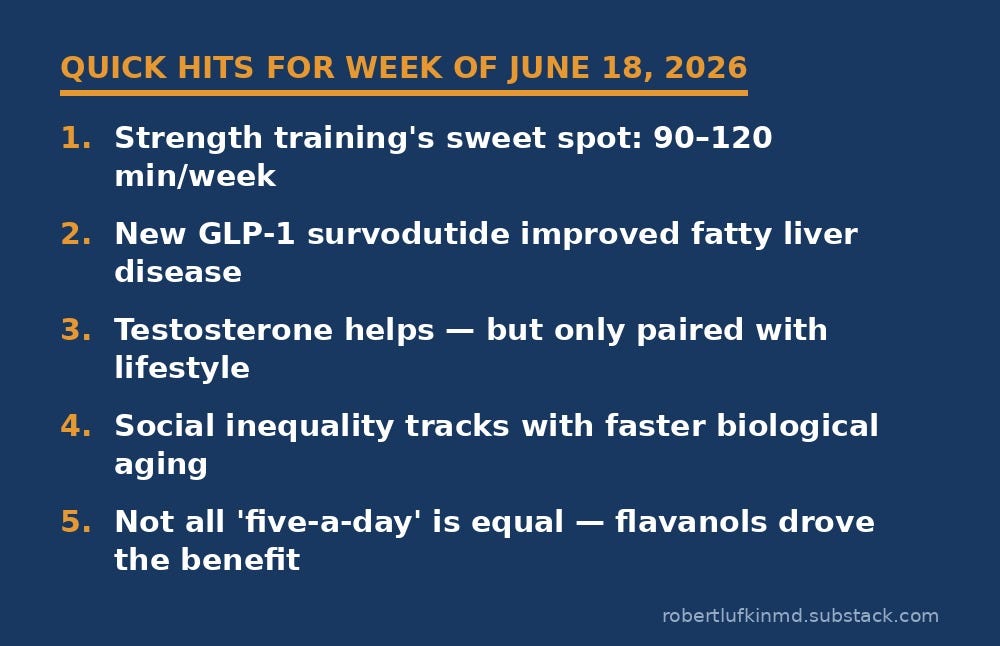
1. The strength-training “sweet spot” for a longer life: 90–120 minutes a week. Tracking over 147,000 people for up to 30 years, researchers reporting in the British Journal of Sports Medicine found that 90–119 minutes of weekly resistance training was linked to a 13% lower all-cause mortality risk — plus a 19% lower risk of cardiovascular death and a 27% lower risk of neurological death. More than 120 minutes added nothing. Pairing it with aerobic work amplified the benefit. The metabolic read: muscle is an endocrine organ, and you don’t need to live in the gym to bank the returns.
2. A new GLP-1, survodutide, hit hard in fatty liver disease. The SYNCHRONIZE-1 trial, reported via the American College of Cardiology, showed the dual glucagon/GLP-1 agonist survodutide produced significant improvement in MASH (metabolic dysfunction-associated steatohepatitis) — the liver’s manifestation of insulin resistance. Promising, and worth watching, but this is a drug-trial endpoint on a disease that is fundamentally driven by diet and metabolic health.
3. Testosterone alone is not a metabolic shortcut. Presented at ENDO 2026, the T4DM trial of 1,007 men aged 50–74 found that testosterone improved body composition, glucose control, and libido — but only when paired with a lifestyle program, and most of the glucose benefit faded by year four (Endocrine Society). Lead author Gary Wittert put it plainly: testosterone “is not a replacement for lifestyle intervention, weight management or standard diabetes prevention.” A theme is forming this week.
4. Social inequality may literally speed up biological aging. A study from the Max Planck Institute for Human Development found that markers of social and economic disadvantage track with faster biological aging. It’s observational — we can’t infer causation — but it’s a reminder that the metabolic environment includes stress, access, and circumstance, not just plate and barbell.
5. Not all “five-a-day” portions are equal for your heart. Tracking more than 30,000 people across the UK and U.S. with actual biomarker measurements, researchers writing in Food & Function found that flavanol-rich choices — blueberries, blackberries, plums, cherries, broad beans, green tea — drove the cardiovascular benefit. Fewer than one in five people hit the ~500 mg/day flavanol threshold linked to lower heart-disease death, even among those eating five portions. What you count matters more than the count.
THE THROUGH-LINE THIS WEEK
Four of this week’s stories — the DPP lead, the T4DM testosterone trial, the survodutide liver data, and the flavanol study — circle the same truth from different angles: insulin resistance and the daily inputs that drive it sit upstream of almost everything we call “aging.”
The DPP trial is the cleanest statement of it I’ve seen in years. Twenty years out, a modest behavioral intervention beat a glucose-lowering drug at preventing the accumulation of chronic disease — not because metformin is useless, but because multimorbidity is a metabolic-systems problem, and you treat systems by changing inputs, not by patching a single output. The testosterone data say the same thing in a different vocabulary: the hormone helps, but only as an amplifier of lifestyle, never a substitute. Even the strength-training “sweet spot” fits — resistance training is, at its core, an insulin-sensitizing intervention with a remarkably low effective dose.
The practical takeaway isn’t new, but the evidence keeps getting stronger: protect your insulin sensitivity. Lift twice a week. Eat the flavanol-dense plants, not just any plants. Move 150 minutes a week. None of it is glamorous. All of it compounds.
GO DEEPER
If this lens is useful to you, the long-form work lives in two places. The Health Longevity Brief lands here every Thursday with the week’s signal pulled from the noise. And on the Health Longevity Secrets podcast — and in my explainer videos — I sit down with the researchers and clinicians doing this work and go deep on the mechanisms behind the headlines.
Subscribe, forward this to one person who needs it, and reply with what you’d like me to dig into next. Your questions shape what I cover.
Live well, longer,
Robert Lufkin, MD
This newsletter is for educational purposes only and is not medical advice. It does not establish a doctor-patient relationship. Always consult your own physician before making changes to your medications, diet, exercise, or health regimen.
For number 4, it would be beneficial to provide research into how someone feels about their socio and/or economic position in life. Attitude is everything and this also needs to be addressed if you are suggesting that lifestyle matters. Mental lifestyle also matters.