
Creatine: The Longevity Supplement Hiding in Plain Sight

For decades, I dismissed creatine as a “gym bro” supplement.
Bodybuilders. Pre-workout shakes. Bigger biceps.
Not relevant to a physician focused on metabolic health and longevity.
I was wrong.
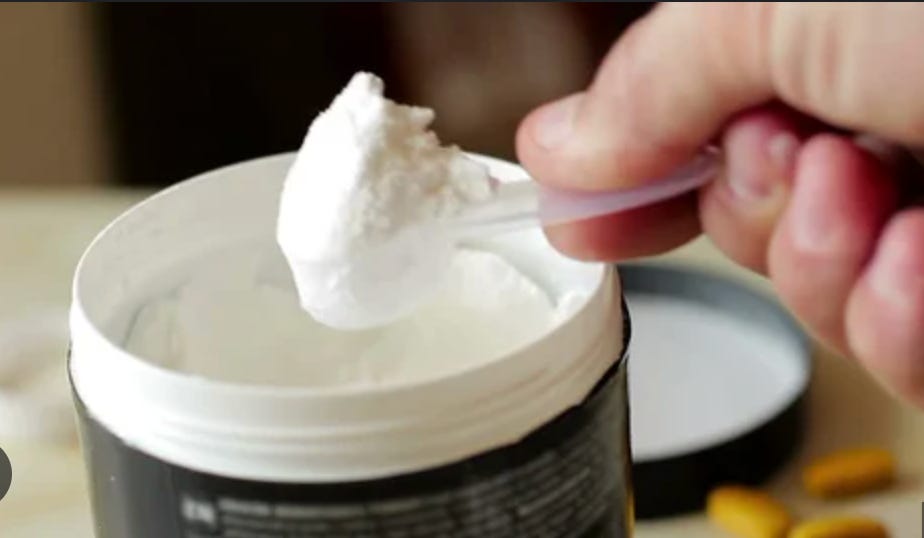
After reviewing the research more closely, I’ve come to believe that creatine may be one of the most important, overlooked supplements for healthspan — not because of what it does for muscles, but because of what it does for mitochondria.
And if you’ve followed my work — especially in Lies I Taught in Medical School — you know that mitochondrial energy is the foundation of nearly every chronic disease we face.
Let’s break this down.
The Real Epidemic: An Energy Crisis
Everything in your body runs on ATP.
Every thought.
Every heartbeat.
Every muscle contraction.
Every immune response.
Your mitochondria take nutrients and convert them into ATP — the energy currency of life.
But modern life is brutal on mitochondria.
Overnutrition.
Sedentary living.
Sleep deprivation.
Chronic stress.
Environmental toxins.
Nutrient deficiencies.
When mitochondria falter, energy production drops. And when energy drops:
Brain fog increases
Muscles weaken
Metabolism slows
Inflammation rises
What we call “chronic disease” is often just chronic energy failure.
Which brings us to creatine.
Creatine Is Not a Muscle Supplement. It’s an Energy Molecule.
Creatine is a naturally occurring compound your body makes from amino acids (glycine, arginine, methionine). You also get small amounts from red meat and fish.
Its role?
It acts as an energy buffer system.
When ATP is used, it loses a phosphate and becomes ADP.
Creatine phosphate can donate a phosphate back to ADP — instantly regenerating ATP.
Think of it as a backup battery for your cells.
This is why athletes use it. More available ATP means:
More strength
More reps
Faster recovery
But here’s the key insight:
This energy system exists in every cell in your body.
Your brain uses it.
Your heart uses it.
Your immune cells use it.
Creatine isn’t a muscle supplement.
It’s a cellular energy supplement.
Creatine and the Brain
Your brain consumes about 20% of your total energy.
It is one of the most metabolically demanding organs in your body.
A systematic review in Experimental Gerontology found that creatine supplementation improved short-term memory and reasoning ability in healthy adults.
Two groups saw particularly strong effects:
Vegetarians — they get almost no dietary creatine, so baseline levels are lower.
Stressed or sleep-deprived individuals — stress increases brain energy demand and impairs mitochondrial function. Creatine appears to buffer that deficit.
There’s also emerging research on creatine in:
Depression
Traumatic brain injury
Age-related cognitive decline
What do all of these conditions share?
Impaired cellular energy metabolism.
From a “Good Energy” framework, creatine isn’t treating symptoms.
It’s supporting the machinery.
Beyond Muscle and Brain
Heart Health
Your heart beats about 100,000 times per day.
It relies heavily on phosphocreatine for energy buffering. Some studies suggest creatine may support cardiac performance and rehabilitation in heart failure.
Blood Sugar & Metabolism
Creatine has been shown in some studies to enhance glucose uptake into muscle, especially when combined with exercise — directly supporting metabolic health.
Sarcopenia
Loss of muscle mass is one of the strongest predictors of frailty and mortality as we age.
Creatine plus resistance training is one of the most effective interventions we have to combat age-related muscle loss.
Mitochondrial Protection
Some research suggests creatine may help reduce oxidative stress and protect mitochondria.
Again — this all comes back to energy resilience.
The Kidney Myth
This is the most common concern I hear.
“Doesn’t creatine damage the kidneys?”
Short answer: No — not in people with healthy kidneys.
Here’s where confusion arises:
Creatine supplementation increases creatinine levels.
Creatinine is used in eGFR calculations (estimated kidney function).
If a physician doesn’t know you’re taking creatine, your labs can appear falsely abnormal.
It’s not kidney damage.
It’s math.
If you want a clearer assessment of kidney function while taking creatine, ask for a cystatin C test instead.
Cystatin C is not affected by creatine intake, muscle mass, or diet.
Other myths:
“Creatine makes you fat.” → Initial weight gain is water in muscle, not fat.
“Creatine causes hair loss.” → Based on one small study showing a slight DHT rise within normal range. No actual hair loss was measured.
For most healthy individuals, creatine is one of the most studied and safest supplements available.
If you have pre-existing kidney disease, discuss supplementation with your physician.
How I Recommend Taking It
Form
Creatine monohydrate. Period.
It’s the most studied, most effective, and cheapest.
Ignore expensive “advanced” forms.
Dose
For muscle:
5 grams daily works well.
For cognitive effects:
Research suggests higher dosing may be required.
Loading phase:
20 grams daily for 5–7 days
Maintenance:
5–10 grams daily
GI Tolerance
Creatine is osmotic.
If you dump it into a glass and chug it, you may get stomach upset.
Sip it slowly over 10–15 minutes and take with food.
Caffeine Timing
Some data suggest high-dose caffeine may interfere with creatine’s muscle effects.
To be safe:
Take creatine first thing in the morning.
Wait about 45 minutes before coffee.
Cost
About $15–20 for a two-month supply.
Roughly 10–20 cents per day.
There are very few interventions in medicine that are this inexpensive and this well studied.
The Bigger Picture
Most chronic diseases are downstream of cellular energy failure.
When mitochondria can’t produce energy efficiently:
Metabolism collapses
Brain function declines
Inflammation increases
Resilience drops
Creatine supports the ATP system directly.
It doesn’t mask symptoms.
It strengthens the engine.
Is it a magic pill?
No.
But if you’re building a metabolic health foundation focused on:
Resistance training
Sleep optimization
Nutrient density
Glucose control
Creatine belongs in the conversation.
Final Thoughts
I changed my mind about creatine.
Not because of gym culture.
Because of mitochondria.
If we truly believe that healthspan is about cellular energy, then creatine may be one of the simplest tools we have to support it.
Cheap.
Safe.
Evidence-based.
Foundational.
Sometimes the “king of supplements” isn’t flashy.
It’s just fundamental.
—
If this was helpful, consider sharing it with someone who still thinks creatine is just for bodybuilders.
And if you want to go deeper on how energy metabolism drives chronic disease, check out Lies I Taught in Medical School.
The future of longevity may not be exotic.
It may just be energetic.
Love it and feel so energized when I take it!
Creatine is one of the most well studied supplements we have, and beyond strength it supports the phosphocreatine system that buffers ATP in muscle, brain, and heart, with solid evidence for improving high intensity performance, enhancing training adaptations, and modest cognitive benefits under stress or sleep loss. It is not a longevity drug, but as a safe, low cost way to support cellular energy and preserve muscle mass which strongly predicts survival, it absolutely deserves a place in the conversation.